Drive-In Racking vs Pallet Shuttle Systems
Drive-in racking vs pallet shuttle systems: how the two high-density configurations compare on density, selectivity, rack damage, stock rotation, and throughput, and what it takes to convert from one to the other.
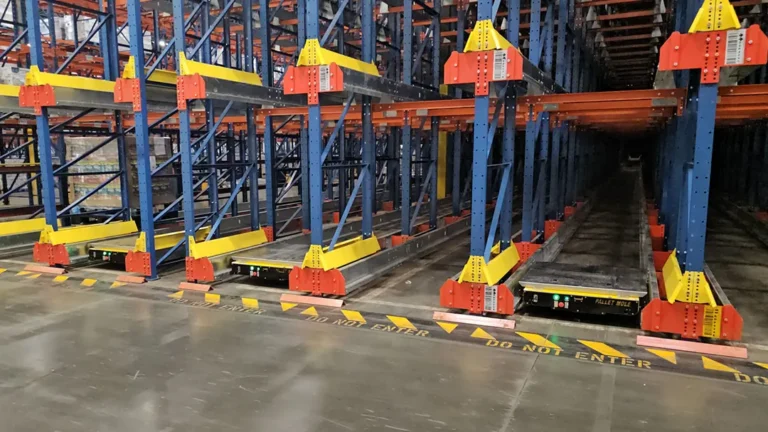
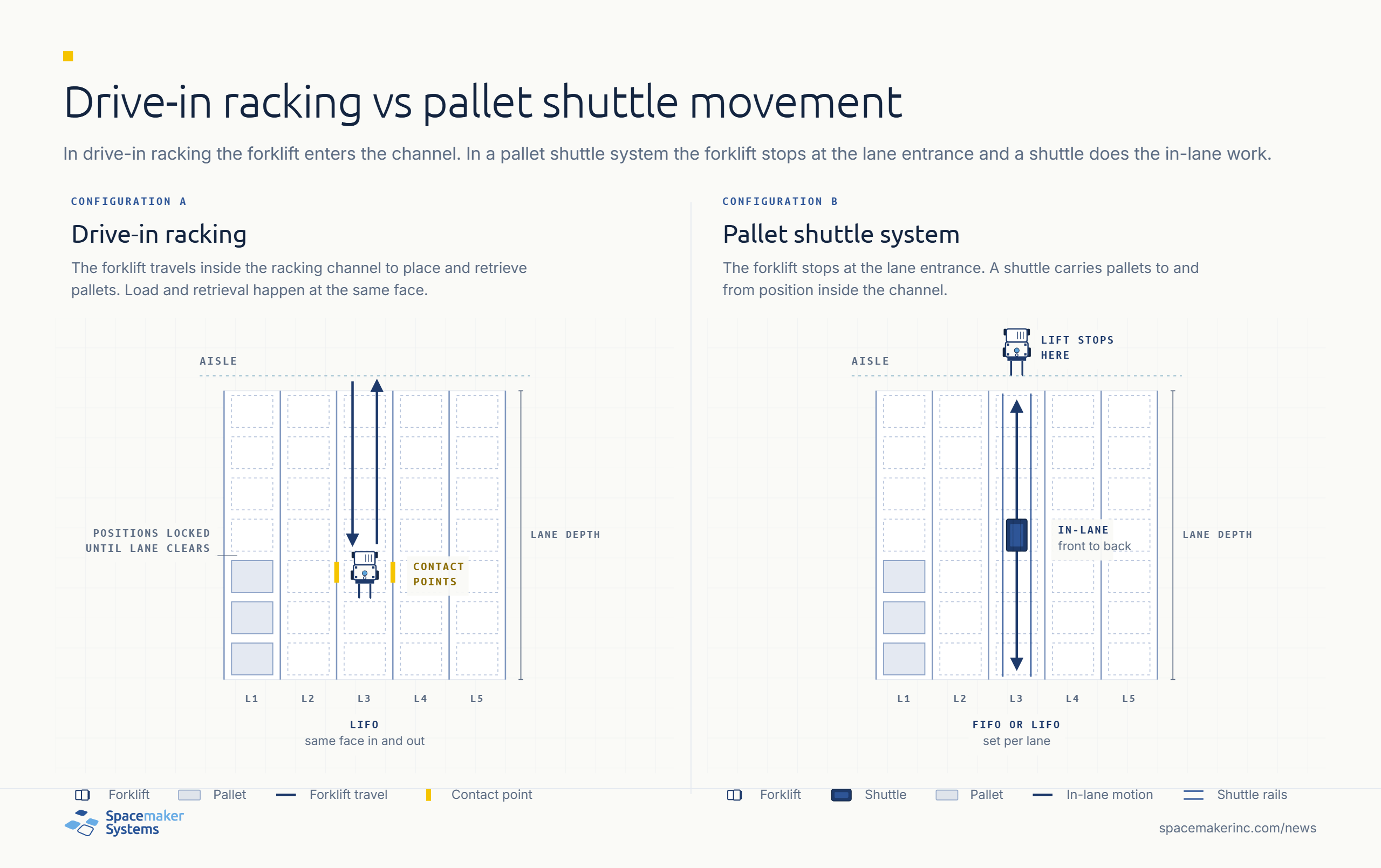
Drive-in racking and pallet shuttle systems solve the same problem. Both store pallets in deep lanes and remove the forklift aisle between every row. The difference is what travels into the lane. In drive-in racking, a forklift enters the structure with an operator in the seat. In a shuttle system, a battery-powered cart lives in the rack and does the in-lane work. Every other difference between the two configurations follows from that one.
What drive-in racking does well
Drive-in racking is the original high-density configuration and it still earns its place in certain operations. It reaches around 80% of floor area in storage, it has no powered components to maintain, and it costs less per pallet position to install. That last figure is a purchase price rather than a cost of ownership, and the two diverge over the life of an installation.
For an operation holding a small number of SKUs at high pallet counts, with no date-driven rotation requirement and no capital available for automation, drive-in remains defensible. The structure is simple, the failure modes are mechanical and visible, and any forklift in the fleet can work it.
The constraints show up in operation rather than on the drawing. Three of them compound.
The forklift is inside the rack
An operator driving a loaded truck into a narrow steel channel makes contact with uprights. Not on every cycle, but often enough that damage accumulates across a lane, and drive-in structures absorb that damage in the same members that carry the load. Repair work means emptying the lane. Deep lanes slow the cycle further, because travel inside the channel is careful travel, and the deeper the lane the longer each pallet takes.
That damage is the ongoing cost, and it is the reason the installed price and the cost of ownership separate. Contact damage arrives as rack repairs, replacement components and service visits across the life of the installation, and every repair costs the positions in the lane as well as the parts. It is also unplanned by nature, and it scales with how hard the lanes are worked and how deep they run, so the operations doing the most with the configuration pay the most to keep it standing. A shuttle system moves that traffic out of the structure, which converts an unplanned repair stream into scheduled maintenance on the fleet. That is where the gap in purchase price closes.
Rotation is last in, first out
Pallets enter and leave through the same face, so the last pallet loaded is the first available. For non-perishable buffer stock that matches production flow. For dated product it forces workarounds: shorter lanes, dedicated lanes per production date, or manual restaging that gives back the density the configuration was chosen for.
Selectivity: reaching one pallet means moving others
A lane holding four pallets in a 12-deep channel cannot accept a different SKU until it clears. Positions sit empty and unusable. Across a large drive-in block that gap between nominal and working capacity is often the difference between the density on the plan and the density on the floor.
The same limit applies vertically. A drive-in truck travels the lane itself, so positions higher in the rack are reached only once the pallets in front of and below them have been moved out of the way. Pallets get handled a second and third time purely to reach other pallets, which is labor and truck time spent on movement that stores nothing.
| Drive-in racking | Pallet shuttle system | |
|---|---|---|
| In-lane equipment | Forklift and operator enter the channel | Battery-powered shuttle stays in the rack, forklift works the entrance only |
| Cube utilization | Around 80% of floor area, LIFO only | 80% to 90%, with rotation configurable per lane |
| Stock rotation | LIFO | FIFO or LIFO, set per lane to suit the SKU |
| Selectivity | Reaching a pallet can require moving others, including clearing lower positions to access those above | Any position served on command, no pallet moved to reach another |
| Rack damage | Cumulative contact damage to load-bearing members | No lift travel inside the channel |
| Practical lane depth | Typically 6 to 12 pallets before cycle time bites | 10 to 32 pallets, with 24 to 26 the common design optimum |
| Cycle per pallet | Rises with depth, operator dependent | 60 to 120 seconds, consistent across shifts |
| Operator time in the lane | Full load and retrieval cycle | None |
| Installed cost | Lower per position at purchase | Higher per position at purchase |
| Ongoing cost profile | Unplanned. Rack repairs, replacement components and service visits driven by in-lane contact, rising with traffic and lane depth, with lost positions while a lane is emptied for repair | Planned. Scheduled maintenance on the fleet, with no contact damage to the structure |
| Control and visibility | Manual operation, no data layer, lane counts done on foot | Handheld RF control of up to 240 shuttles, live inventory and cycle times in a browser, WMS integration |
What changes with a shuttle
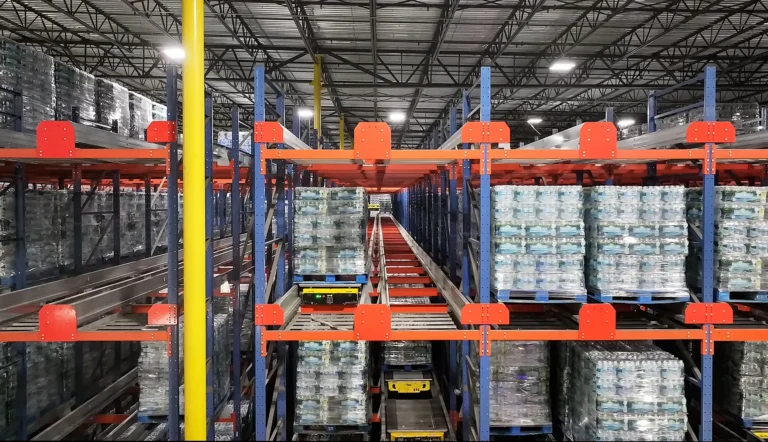
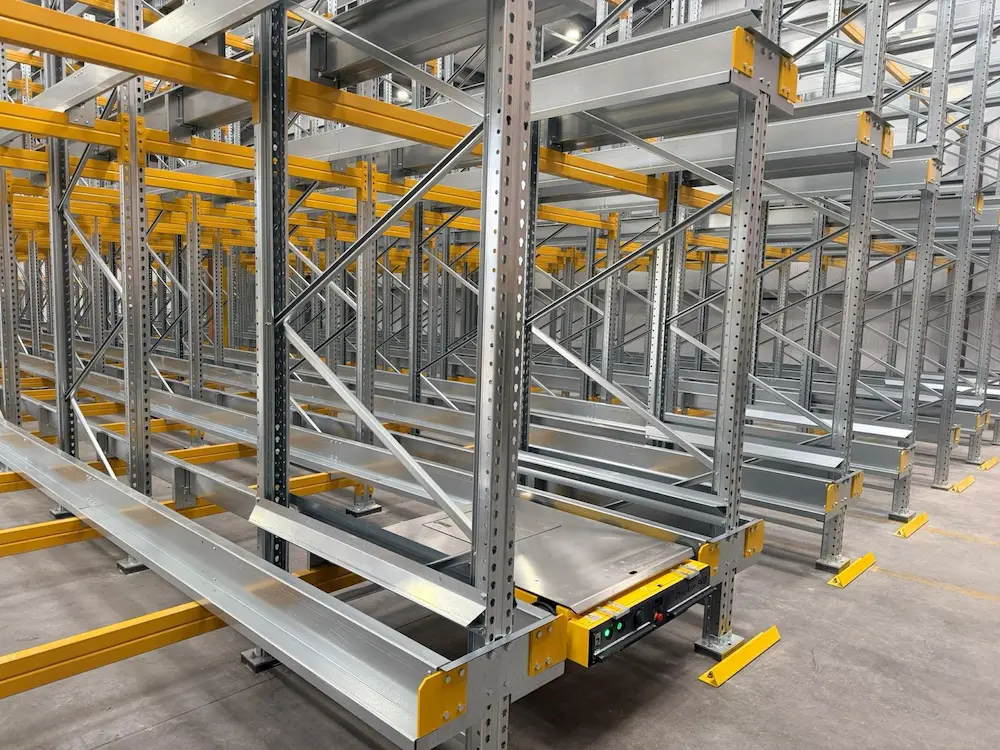
A pallet shuttle is a battery-powered cart that runs on rails inside the lane, carrying pallets to and from storage positions on command. The forklift places a pallet at the channel entrance and moves on.
Cycle time settles at 60 to 120 seconds per pallet and holds there regardless of who is driving, because the variable part of the cycle moved off the forklift. Rotation becomes a per-lane setting, so dated product runs FIFO in one channel while buffer stock runs LIFO in the next. A compaction mode closes gaps in partially filled lanes and recovers the positions that a drive-in block would leave stranded.
Because the shuttle serves the lane and the lift never enters it, no pallet has to be moved to reach another one. Any position is available without rehandling what sits in front of it, which is where the productivity gain shows up as fewer truck moves and fewer people to achieve the same throughput.
Lane depth opens up. Drive-in gets slower with every pallet of depth added, which caps most installations well short of the structure’s limit. Shuttle productivity holds to around 32 pallets deep, with 24 to 26 the common design optimum, so the same footprint carries more positions per aisle.
The operator commands the lane from outside it
The shuttle takes its instructions from a handheld RF transmitter. The operator sets the mode from the lane entrance and the shuttle executes it, and one transmitter manages up to 240 shuttles across a facility. Operating modes cover the work directly: automated deposit and retrieval cycles run on command with the shuttle handling the full movement sequence, a continuous deposit mode runs high-volume inbound, a manual mode directs the unit to a specific location when a human needs to be in the loop, and a stock count mode tallies the pallets in a lane and returns the number. Counting a drive-in lane means someone walking it.
Behind the transmitter is a mesh network built for the building rather than adapted to it, so commands hold at range and between aisles without line of sight. Drive-in racking has no equivalent layer at all: lane occupancy is what someone counts on a walk round and cycle times are whatever the shift produced.
The same layer reports. Operators see live inventory and system performance through a browser interface on any device on the network, with throughput, lane occupancy and cycle times available as operating data, and a mobile app gives supervisors fleet status in real time. It integrates upward into an existing WMS or ERP through REST and message-queue interfaces, with FIFO, LIFO, stock count and pallet shuffle mapping directly to task types on that side. Because the control server is browser-accessible, diagnostics and software updates are delivered remotely rather than requiring a site visit.
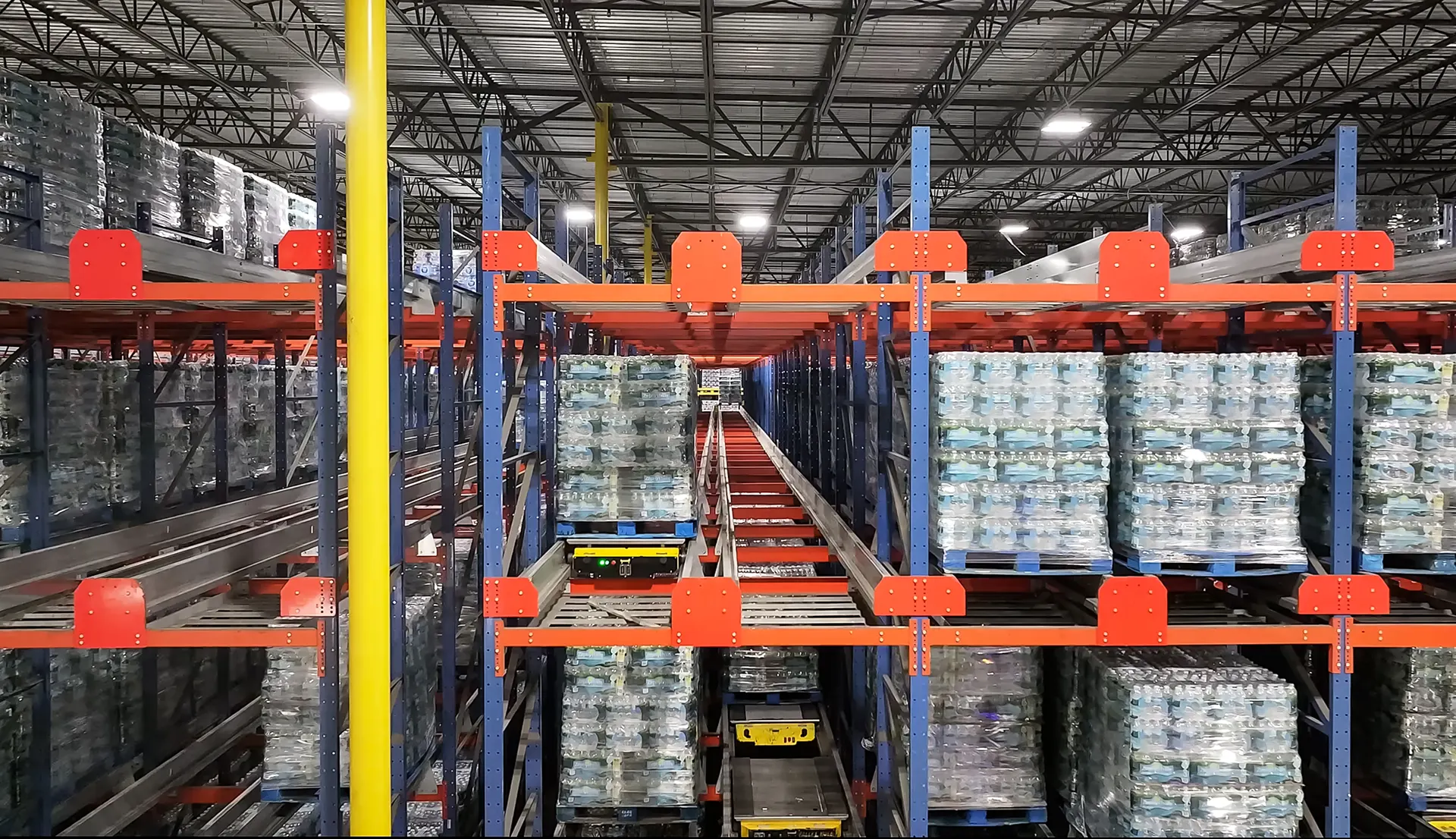
Cold storage is where the two configurations separate hardest. Cold-rated shuttles operate down to -30°C, and supercapacitor-powered automated configurations reach -40°C. The operator places a pallet at the channel entrance and leaves the cold zone instead of driving the full cycle inside it, which cuts exposure time and keeps freezer doors closed longer.
When drive-in is still the right call
Shuttles are the wrong answer in several situations, and it is worth being direct about them. Lanes under about six pallets deep rarely justify the equipment. Operations with low pallet counts per SKU will leave shuttles idle while lanes sit part-filled, which is the same utilization problem drive-in has with the added capital. Temporary or seasonal storage that will be reconfigured inside a year is hard to justify against a shuttle payback period. Where capital is the binding constraint and rotation genuinely does not matter, drive-in is doing its job.
Converting existing drive-in racking
Shuttle rails can often mount into existing deep-lane structure rather than requiring a new build, which is why the comparison usually turns into a retrofit question. Whether a specific block converts depends on upright and frame spacing, the condition of members that have absorbed years of contact, floor flatness along the lane, beam levels, and pallet quality. Floor flatness is the one that most often decides it: a lane with an incline makes a shuttle work against the grade in one direction and run away with the load in the other, so tolerance data is a design input rather than a detail.
Any operation weighing the two configurations starts with two numbers: pallets on hand per SKU, and the lane depth those pallets would fill. Those two figures decide whether deep-lane storage suits the operation at all, and everything else in this comparison follows from them.
Frequently asked questions
What is the difference between drive-in racking and a pallet shuttle system?
Both are deep-lane, high-density configurations that remove the forklift aisle between rows. In drive-in racking, a forklift drives into the channel to place and retrieve pallets. In a pallet shuttle system, a battery-powered cart runs on rails inside the channel and the forklift works only at the lane entrance. That difference determines rack damage exposure, rotation options, achievable lane depth, and cycle time consistency.
Can a pallet shuttle system be installed in existing drive-in racking?
Often, yes. Shuttle rails mount to the racking beam structure, so an existing deep-lane block can be a candidate for conversion rather than replacement. Suitability depends on upright and frame spacing, the structural condition of members that have taken contact damage, floor flatness along the lane, beam levels, and pallet quality. A site survey with floor flatness data confirms whether a specific block converts.
Does a pallet shuttle system support FIFO rotation?
Yes. Rotation is configurable per lane, so a single installation can run FIFO in channels holding dated product and LIFO in channels holding buffer stock. Drive-in racking is LIFO only, because pallets enter and leave through the same face. For operations with date-driven rotation requirements this is usually the deciding difference between the two configurations.
Does drive-in racking offer good selectivity?
No, and it is the main operational trade-off. Pallets are reachable only from the lane face, so retrieving a specific pallet can mean moving others first, including clearing lower positions to reach those above. A pallet shuttle system serves any position in the lane on command, so no pallet is handled to reach another.
How much storage density does a pallet shuttle system add over drive-in racking?
Drive-in racking reaches around 80% of floor area in storage, in LIFO mode only. Pallet shuttle configurations reach 80% to 90% with rotation configurable per lane. The larger practical gain comes from lane depth and utilization: drive-in cycle time rises with depth, which caps most installations short of the structure’s limit, while shuttle productivity holds to around 32 pallets deep. Compaction mode also recovers positions in part-filled lanes that a drive-in block leaves unusable.
Is a pallet shuttle system more expensive than drive-in racking?
At purchase, yes. Drive-in racking costs less per pallet position to install, because it has no powered components. Over the life of an installation the comparison changes. Forklifts working inside a drive-in channel make contact with the uprights, and that damage lands in the members carrying the load, so it returns as rack repairs, replacement components and service visits, with lane downtime on top. A shuttle system keeps the lift at the lane entrance, which removes that stream rather than reducing it. The honest framing is that drive-in wins on installed cost and the two diverge from there.
Do pallet shuttles work in freezer environments?
Yes, using cold-rated configurations built with insulated electronics, sealed components, and cold-rated lubricants. Published operating ranges extend to -30°C for lithium battery systems and -40°C for supercapacitor-powered automated configurations. A cold-storage shuttle is a distinct engineering product from an ambient unit, so the operating temperature range belongs in the specification at RFP stage. Around half of Spacemaker projects are in cold storage environments.
When is drive-in racking the better choice?
Drive-in suits operations with lanes under about six pallets deep, low pallet counts per SKU, no date-driven rotation requirement, temporary or seasonal storage due for reconfiguration, or a binding capital constraint. In those cases the lower cost per position and the absence of powered components outweigh what a shuttle system adds. The evaluation starts with pallets on hand per SKU and the lane depth those pallets would fill.